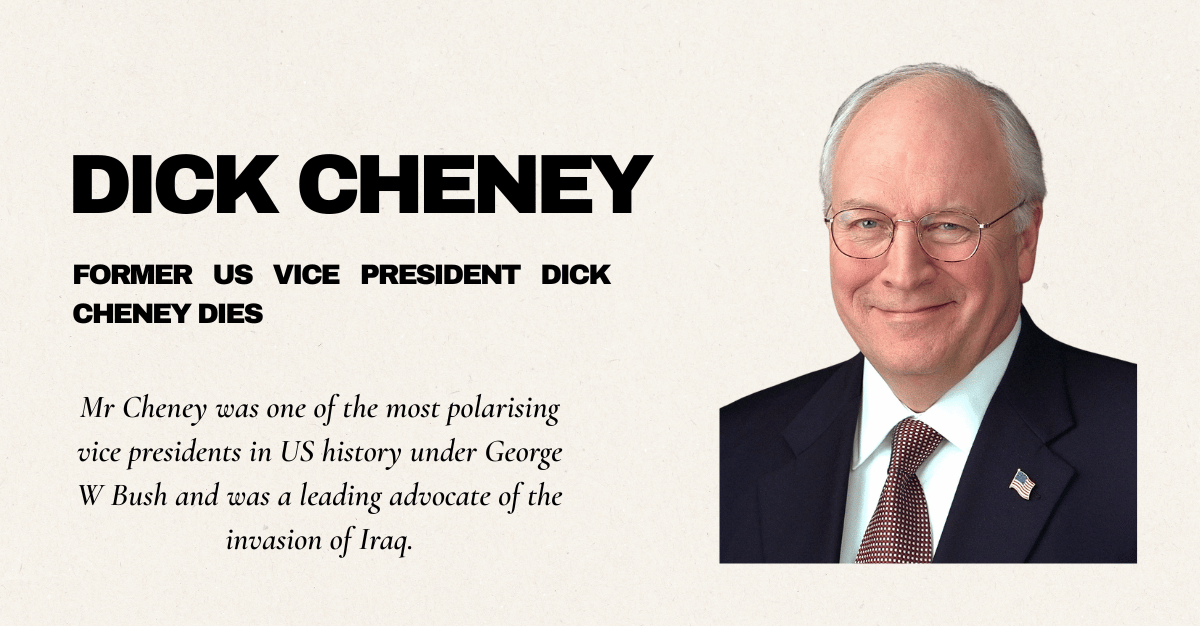
Published Nov 04, 2025
Richard Bruce “Dick” Cheney was no one’s idea of a charismatic photograph. He was lean, serious, a man whose handshake was firm and whose gaze suggested quiet calculation. Born in Lincoln, Nebraska in 1941, he moved with his family to Wyoming. He rose through politics with a mixture of savvy, determination and a willingness to wield power behind the scenes.
Before his name graced the podium as Vice President, Cheney had already served as White House Chief of Staff under Gerald Ford, then as a U.S. Congressman for Wyoming, and later as Secretary of Defense under George H. W. Bush during the Gulf War. Each stage built the armour of experience and influence he would bring into the 21st century.
When the terror attacks of 11 September 2001 struck America, Cheney was at the centre of decision-making. Under President George W. Bush, he became a key architect of the “War on Terror” response. He believed in presidential resolve, expansive executive powers and pre-emptive action. In the wake of the attacks, Cheney pushed for the invasion of Iraq in 2003, citing threats that many now regard as overestimated. The invasion remains controversial, but it also changed the course of world history.
Cheney’s was a quiet kind of dominance. Unlike some leaders who burn bright in the public eye, he preferred the corridors behind the stage. He was often referred to as the most powerful vice-president in U.S. history — because he did not confine himself to being number two. His office became a hub of strategy, intelligence and policy. He embraced it. Critics called him secretive, aggressive, over-mighty, but supporters called him steady, necessary, patriotic.
In 2006 Cheney survived a bizarre late-afternoon incident: a hunting accident in Texas where he accidentally shot his friend. It reminded Americans that even the most hardened officials bear mortal fragility. And though his health had long been precarious — multiple heart attacks, a heart transplant in 2012 among them — he carried on.
After leaving office in 2009, Cheney’s public life didn’t fade into quiet obscurity. He became a voice of his generation, staking controversial positions and sometimes diverging from his party. In 2024 he endorsed a candidate in the presidential race from across the political aisle, calling someone he once aligned with “the greatest ever threat to our republic”. It was a striking coda to a man who once upheld strong party loyalty.
On 4 November 2025, Cheney died aged 84 from complications of pneumonia, cardiac and vascular disease, his family announced. He was surrounded by his wife Lynne and daughters Liz and Mary. His passing was the final chapter of a life that cast long shadows. His critics remembered the wars, the secrecy, the controversies. His admirers spoke of strength, order and commitment.
His legacy is tangled. He expanded the machinery of presidential power, reshaped U.S. foreign policy, and altered how America uses its military and intelligence services. Many argue his influence still shapes the world: the global war-on-terror apparatus, the executive branch’s shape, the conversations about surveillance and national security.
Yet the question remains as fresh as ever: did the means justify the ends? Did his vision keep America safe — or did it open new battlegrounds and raise new moral dilemmas? The mixed verdict of history will decide, but for now his story is over, and the echoes will remain.
In politics, few leave footprints as deep yet controversial. Dick Cheney did. He changed the role of the vice-president. He helped steer America through one of its most turbulent dawns. And he reminded us how power, when quietly concentrated, can move mountains while staying out of view.
The man who once said that the only agenda he would have was the president’s agenda left behind a larger agenda anyway. Whether you view him as guardian or architect of an age of conflict, his life is a study in reach, influence and complexity.
And so the story ends — not with the flash of cameras but with a quiet exhalation from a man who spent decades holding the levers of power. Age 84, he passed into history. The country he helped shape now carries on, but with one of its most formidable architects gone.